.svg)
.svg)
.svg)
.svg)
.svg)
.svg)
Resilience - Roger Federer
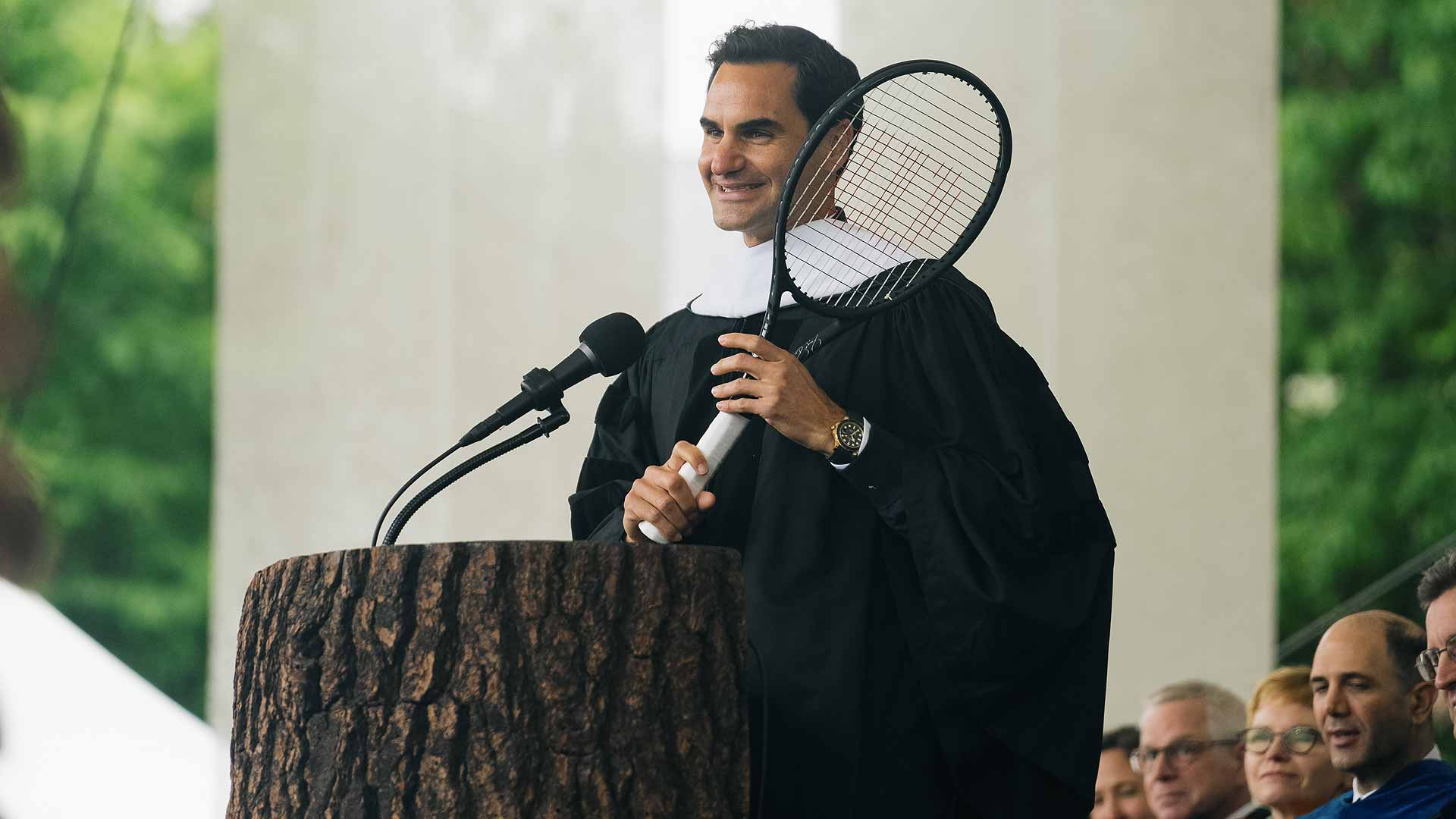
Roger Federer Commencement Speech at Dartmouth https://home.dartmouth.edu/news/2024/06/2024-commencement-address-roger-federer#modal
Provided by Boots On The Ground
Boots On The Ground is an anonymous helpline providing confidential peer support to First Responders and Public Safety Personnel across Ontario, available 24 hours a day, 7 days a week.

If you need support beyond this resource, help is available
This site offers immediate, stigma-free mental health resources for trauma-exposed public safety personnel (both uniform and civilian) in Ontario. Access confidential support 24/7 through free online resources or if in immediate crisis, call 911, Homewood Health’s 24/7 crisis line at 1-833-866-9929, or for 24/7 peer support call Boots on the Ground at 1-833-677-2668.
Resilience: Rising Up After the Fall Can you guess the percentage of points that Roger Federer, who is widely recognized as one of tennis’ greatest players, has won in matches? Would you believe that he has won only 54% of points in his matches? This may be difficult to believe, but that is exactly what Federer told a 2024 graduating class at Dartmouth1 .
He stated that, while he has won almost 80% of all his matches: “…when you’re playing a point, it has to be the most important thing in the world, and it is. But when it’s behind you, it’s behind you. This mindset is really crucial, because it frees you to commit to the next point, and the next point after that, with intensity, clarity, and focus.”
This mindset offers a powerful lesson about resilience.
At some point in life, we are all going to fail. Are you truly putting forth your best effort if you never take risks? While “playing it safe” may protect us from immediate discomfort, avoiding challenge also deprives us of opportunities to learn, grow, and improve.
Resilience is not about never failing. Rather, resilience is the ability not only to recover from stress and adversity, but to learn and grow because of it.
Think about a time you learned a new skill, whether it was riding a bike, playing a new sport, starting a new hobby, or playing a musical instrument. Were you immediately perfect? No, of course not! You likely made many mistakes, fell off the bike, and played the wrong notes. If you walked away the first time you fell or missed the shot, you would not have grown and eventually improved with your new skill.
“Failure” can feel awful. No one wants to fail. But going back to Federer – if he had walked off the court after missing a few shots, he would not have become the tennis player we all know: “…when you lose every second point on average, you learn not to dwell on every shot.”
Accepting and learning from perceived failures is not about dismissing mistakes you make and their impact on other people. It only works if you accept responsibility for the “failure” and actually learn from it. What might this look like?
Allow yourself to feel what you feel. o Are you feeling embarrassed? Angry? Sad? Disappointed? You’re allowed to feel what you feel. Acknowledge it. Feel it. Sit with it.
Take the time and space to process your reactions. You may need some time to react and figure out what you feel and why.
Self-reflection. Be honest with yourself. Sometimes you are the most difficult person to face when being fully honest.
Do a deep dive – what led to the situation? What thoughts and interpretations led to your responses?
What was the outcome you intended? Was the result what you intended? How might others interpret what you said or did? o Good intentions don’t always translate into the actions we take.
If applicable, ask for constructive feedback from other people who were there and/or know you well.
The key with this step is that you must be open to the feedback. Praise and validation is always nice, but they don’t help us grow.
Are you able to hear – really hear – what they’re telling you?
Hearing feedback is particularly difficult if you haven’t taken the time and space to process your own reactions!
What can you learn from this situation?
What would you do differently if the same situation happens again?
Acknowledge the impact of the situation on others, and make amends or repair as needed.
Failure is not a verdict on our worth or ability – it does not reflect who we are. Failures and setbacks are a crucial part of the process of becoming better, wiser, and more capable. We can regret the past but we cannot change the past – we can only learn and grow from the past. Resilience allows us to rise after the fall, carrying forward the lessons rather than the weight of the mistake, and continue to progress one point, one step at a time.